The New GCC–India Growth Model
How better partner selection, smarter market entry and stronger commercial execution can reduce risk and accelerate expansion

For GCC companies, India has never been short of opportunity. The real challenge is not finding another supplier, distributor or contact. It is identifying the right commercial partner, structuring the relationship correctly, and moving from introduction to execution without losing months to noise, weak qualification or avoidable risk. I see this repeatedly in cross-border business conversations. A company has an India requirement, the search begins, and within days there are dozens of names, quotations and introductions.
The volume creates an impression of progress. In reality, the most important question often remains unanswered: which of these companies is actually right for our business?
The current practice: access first, qualification later
A large part of GCC–India sourcing still starts in familiar ways: existing contacts, referrals, exhibitions, online supplier directories, brokers, unsolicited proposals and price comparisons. These channels are useful. They create access. But access and suitability are not the same thing. A conventional process often looks like this: find a supplier, request a quotation, compare prices, ask for a sample and begin negotiations. The process answers, “Who can sell this?” It does not automatically answer the questions a GCC decision-maker should care about: Can the supplier handle the required scale?
Is the quality system consistent? Does the company understand export documentation and GCC expectations? Is the margin sustainable? Is there appetite for private label, exclusivity or regional expansion? Can the relationship survive after the first order? The cheapest acceptable quote can win a transaction. It rarely guarantees the right long-term partner.
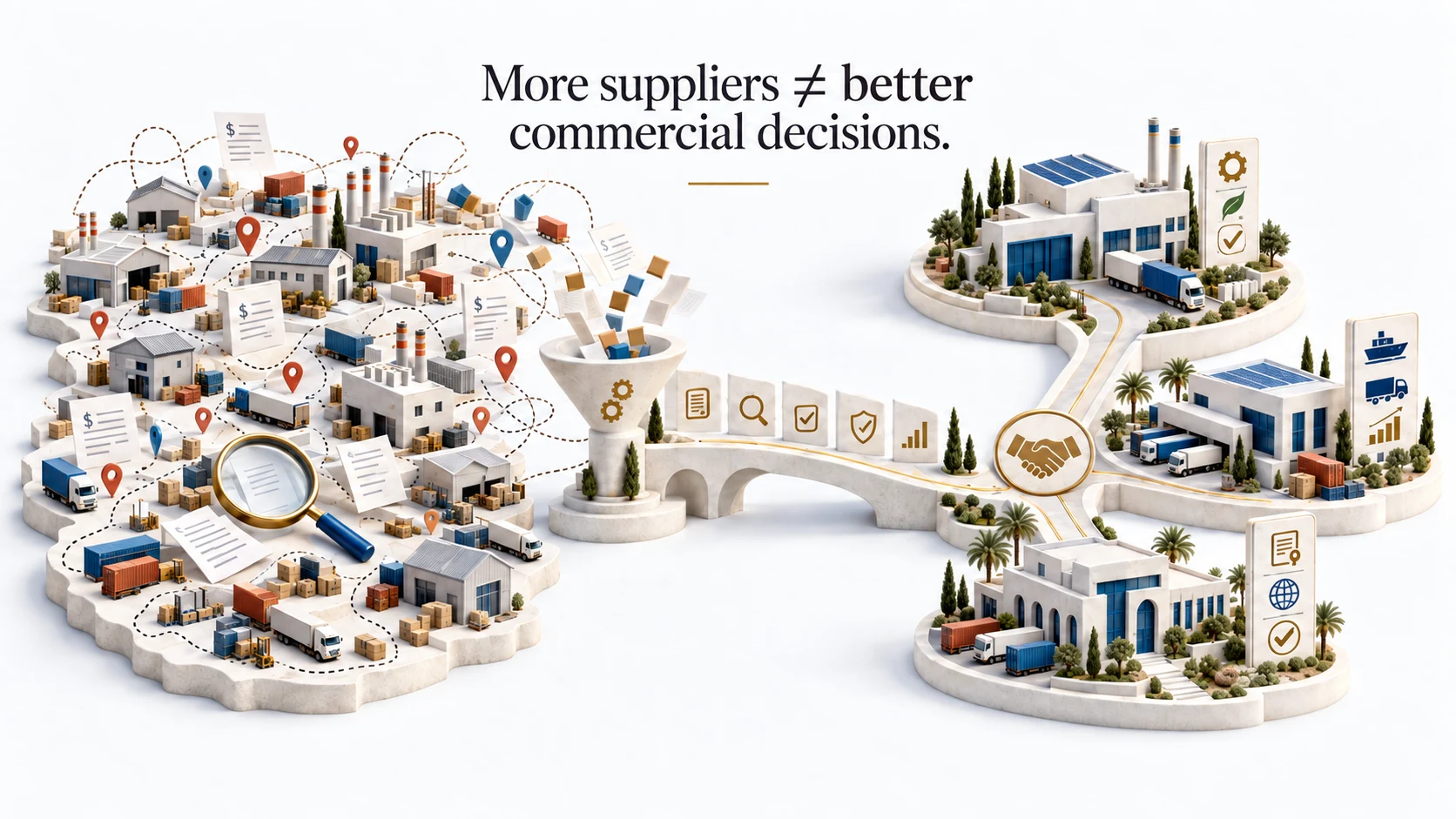
The real pain point is not access. It is commercial qualification.
India’s business ecosystem is enormous. That is an advantage, but it also creates commercial noise. A buyer may have hundreds of possible companies in a category. A market-entry team may find dozens of distributors. A manufacturer may receive multiple expressions of interest. The value is not in having more names. The value is in reducing a wide universe of possibilities to a small number of credible conversations.
For a GCC leader, the practical target may be five qualified suppliers, three serious partners and one relationship that can scale. Getting there requires a disciplined qualification layer: product fit, capacity, geography, legal structure, market relevance, export readiness, operating maturity, commercial intent and relationship potential. This is where sourcing stops being a search exercise and becomes a strategic decision process.
The trade corridor is already large enough to demand a better operating model
The commercial case is no longer theoretical. Dubai’s non-oil trade with India reached a record AED 222.5 billion in 2025, up 15% year on year. Between 2022 and 2025, Dubai–India non-oil trade increased by 35%. By the end of June 2026, 85,841 Indian companies were active members of Dubai Chamber of Commerce. At the UAE level, India was the country’s third-largest non-oil trading partner in the first half of 2026, with trade of AED 107.5 billion.
These numbers matter because they change the management question. When a corridor reaches this scale, informal sourcing alone is not enough. Companies need repeatable methods for partner discovery, qualification, market-entry planning and execution.
CEPA improved the corridor. It did not remove execution risk.
The UAE–India Comprehensive Economic Partnership Agreement (CEPA) came into force in May 2022. The agreement significantly improved market access. Dubai Chambers highlights CEPA’s role in reducing trade barriers and improving access to both markets. That is strategically important. Lower barriers can improve competitiveness, accelerate trade and expand the range of viable cross-border opportunities. But a trade agreement does not select your distributor. It does not test a supplier’s operational reliability.
It does not decide whether you should enter the UAE directly, use an exclusive distributor, pursue private label, build a joint venture or use Dubai as a platform for wider GCC and international expansion. CEPA creates structural opportunity. Commercial execution determines whether a company captures it.
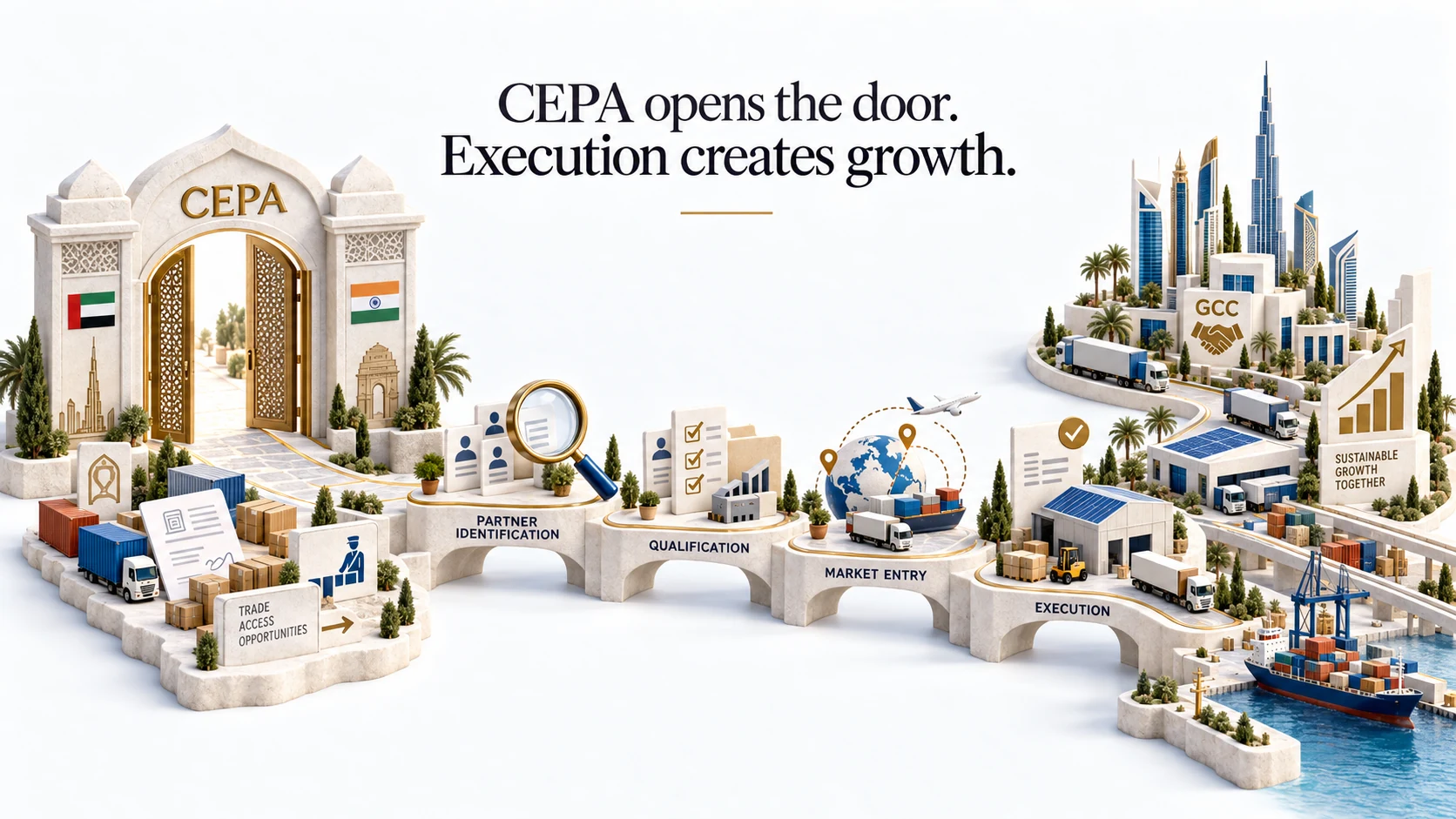
A better GCC–India growth model
I believe the next phase of GCC–India business should be built around four connected disciplines.
1. Partner identification.
Start with the commercial requirement, not with a list of companies. Define the product, capacity, target segment, geography, price positioning, certification requirements, distribution model and growth ambition first. Then search for companies that fit the brief.
2. Commercial qualification.
Not every available supplier or distributor deserves management time. Screen for relevance, operating capability, business structure, market fit, export readiness and willingness to build the type of relationship you need.
3. Market-entry architecture.
Buying from India and building business with India are different decisions. The strategy may involve direct imports, exclusive or non-exclusive distribution, private label, OEM, local representation, UAE-first entry, wider GCC rollout or Dubai-based re-export. The right structure is part of the value.
4. Commercial execution.
This is the most underestimated layer. Research is useful only when it moves into introductions, qualification calls, samples, commercial discussions, negotiations, documentation, partner alignment and follow-up. A good report that never reaches execution is still only a report.
The question GCC leaders should ask
The old question was: “Who in India can supply this?” The better question is: “Which Indian partner fits our GCC growth strategy, and what is the lowest-risk way to build that relationship?” The difference sounds small. Commercially, it is significant. The first question often leads to price comparison. The second leads to partner selection, market structure and long-term value. This is the role of a specialised cross-border commercial partner: not to provide more contacts, but to create decision clarity and carry the opportunity further into execution.
The work should connect opportunity mapping, partner discovery, qualification, market-entry strategy, introductions, negotiation support and disciplined follow-through.
My view from Dubai
India should not be treated only as a sourcing destination. For GCC businesses, it is a deep commercial ecosystem with manufacturing, technology, services, talent, consumer scale and export capability. At the same time, the GCC — and the UAE in particular — offers Indian companies access to capital, sophisticated buyers, regional distribution, international connectivity and a platform into the Middle East, Africa and beyond. The opportunity is therefore two-way.
The companies that gain the most from this corridor will not necessarily be those with the largest contact books. They will be the ones that make better partner decisions, design the right entry model and execute consistently after the first introduction. CEPA has strengthened the bridge. Trade growth shows that businesses are already crossing it. The next competitive advantage is simple: choose the right partner, reduce avoidable commercial risk and turn cross-border relationships into measurable growth.
“CEPA creates structural opportunity. Commercial execution determines whether a company captures it.”
Sources and data dates
- Dubai Media Office / Dubai Chambers, 24 August 2026: Dubai–India trade and Indian company membership
- Dubai Media Office, 19 July 2026: UAE non-oil trade in H1 2026
Figures refer to the periods stated: Dubai–India trade in 2025, active Dubai Chamber membership at end-June 2026, and UAE–India trade in H1 2026. These are distinct measures. Commentary and the four-part growth model reflect the author’s strategic perspective.
Put this growth model into practice
Choose the support that matches your current business gap.
Lead Generation & Digital Growth
Turn a defined buyer or partner profile into a focused enquiry journey, with qualification questions and follow-up priorities.
Websites & Digital Presence
Give prospective distributors and buyers a clear place to assess capabilities, evidence and the next commercial step.
Branding & Identity
Present a consistent commercial identity across supplier profiles, proposals and partner-facing sales materials.
Arabic-First Creative
Adapt the market-entry message and sales collateral for Arabic-speaking GCC decision-makers.
Authority & LinkedIn Content
Use executive insight and credible market evidence to support trust before a buyer or partner conversation.
AI Content Production
Turn approved market insight into a reusable library of buyer education, product explanations and partner FAQs.
Social Media Management
Distribute useful market-entry content consistently across the channels used by target buyers and partners.
Video & Motion
Explain a complex offer or cross-border operating model in a concise video for outreach and sales conversations.
Discuss your UAE–India growth requirement
Share your product or service, target market, partner requirement and planned timeline. Start a focused conversation with Gulf Entrix about your next commercial step.
Discuss on WhatsAppExplore lead generation and digital growth or read our Arabic guide to assessing an existing Dubai business.